

Hardwood floor guide · Published November 21, 2026
The short answer: most cloudy hardwood has something sitting on the finish
Cloudy hardwood floors are usually caused by something sitting on top of the finish: residue from the wrong cleaner, too much product, store-bought polish, old wax or fine dust. Hank's Carpet Cleaning removes residue and dust with a deep scrub, clean and buff ($0.60 per square foot, $400 minimum). Polish and wax buildup need a hardwood refinishing pro.
The rest of this guide helps you work out which cause you have before you spend money on it. Start with the table below, then read the section for the cause that matches your floor. If you'd rather skip the detective work, text a few photos to (817) 697-7500, including one shot looking across the floor toward a window, and we'll tell you honestly what we see.
What's making your floor cloudy? A quick lookup table
Most hazy floors fall into one of these six groups. The clues are what you see and when it started. The last column says who can fix it.
- Cleaner residue: a smeary film that shows footprints and streaks, often worse after mopping. Usually started after a new cleaner or a "one-step" product. Fix: stop the product, deep clean and buff. Hank's can do this.
- Too much product or too much water: streaks and dull patches in the areas you mop most, sometimes a tacky feel. Fix: change how you mop, then deep clean and buff. Hank's can do this.
- Store-bought polish or "restorer": a shine that faded within weeks and came back hazy, scuffs that show easily, a patchy or milky look after several coats. Fix: polish removal or a sand and refinish by a hardwood refinishing pro.
- Old paste or liquid wax: white haze that changes with the light, tacky spots, a darker film along walls and under furniture edges. Fix: wax removal by a hardwood refinishing pro.
- Fine dust after painting, drywall or remodeling: a gray, flat look across whole rooms that appeared right after the work. Fix: deep clean and buff. Hank's can do this.
- Moisture in or under the finish: white rings or cloudy patches where a plant, pet bowl, wet mop or spill sat, or haze along a door or window. Fix: depends on how deep it goes; often a refinishing pro.
How to tell if the haze is on the finish or in it
This one test does most of the work: haze that sits on the finish can be removed, and haze that's in the finish or the wood can't be cleaned out. You can get a good idea at home in a few minutes.
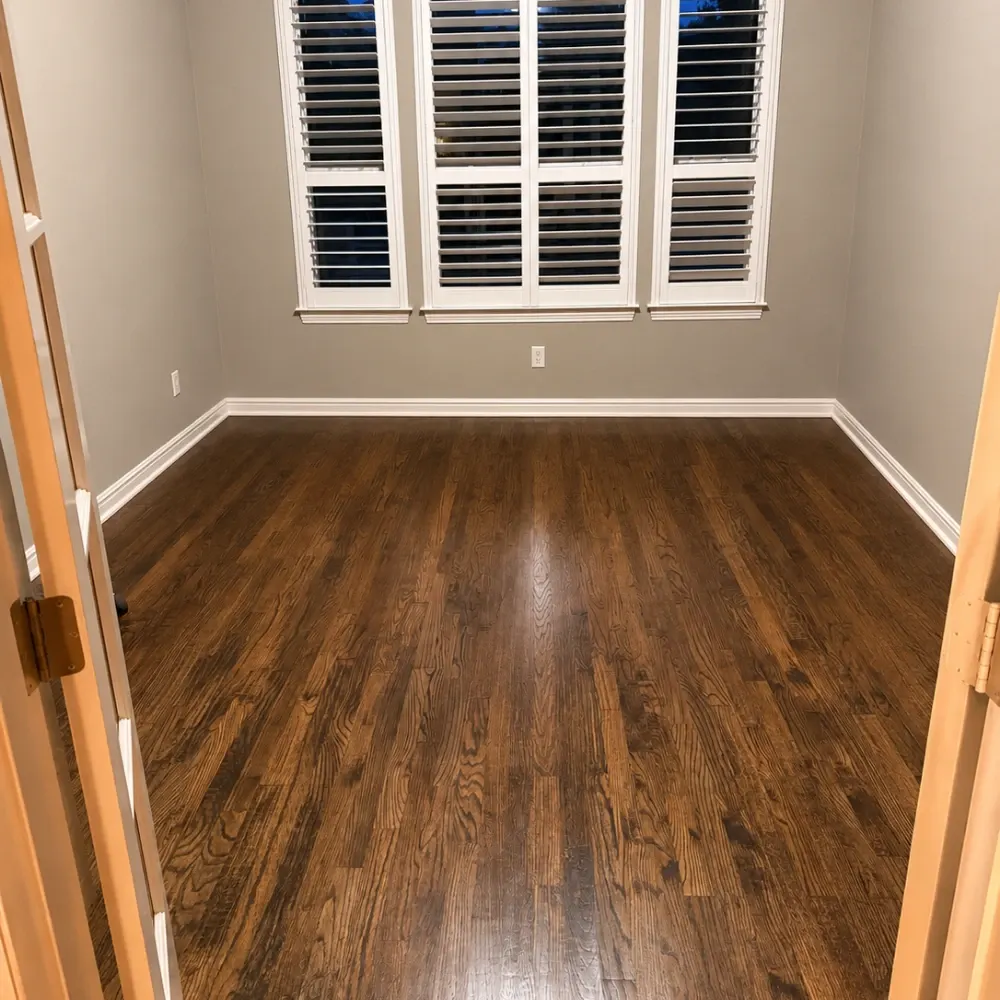
1. Look across the floor toward a window
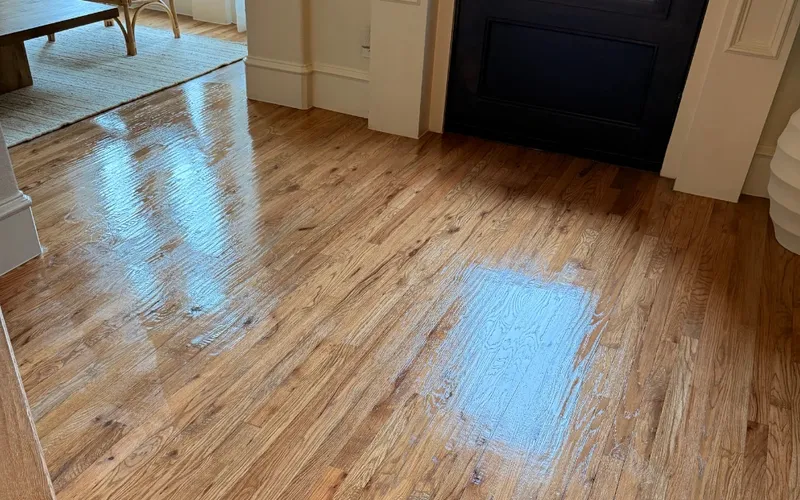
Crouch low and look along the boards toward a bright window or a lamp. Residue, polish and wax show up as smears, swirls, footprints or a milky sheen that changes as you move your head. Damage to the finish looks different: scratches, gray worn paths and white marks that stay put however you look at them.
2. Wipe a small spot with a damp white cloth
Pick a spot you don't mind testing, like an area by the wall that furniture covers. Wipe it with a clean white microfiber cloth barely dampened with plain water, then dry it with a second cloth. If the cloth comes up gray and the spot looks clearer for a minute, you're looking at dirt or residue on top of the finish. If nothing changes, the haze is probably a coating of polish or wax, or it's in the finish itself.
3. Think back to what changed
Most haze has a starting point. A new cleaner, a bottle that says "restore" or "shine", painters or a remodel, a new steam mop, a leaking plant pot. The timing usually points straight at the cause, and it tells us more than any photo.
4. Check the finish type if you can
Most hardwood in DFW homes has a surface finish, a clear coat like polyurethane that sits on top of the wood. Some newer floors have an oil or hardwax-oil finish that soaks in. If you have the builder's paperwork or the flooring box, it will say. The care is different for each, and it matters for the fixes below.
Cause 1: residue from the wrong cleaner
Cleaner residue is the cloudiness we can fix most often. It happens when a product leaves something behind on the finish: soap, oils, fragrance or shine agents. Each mop adds a thin layer, the layer grabs dirt, and the floor starts to look smeary even when it was just cleaned.
The National Wood Flooring Association tells homeowners to use a cleaning product made specifically for the finish on the floor, and not to use vinyl or tile cleaners on wood. All-purpose sprays, dish soap in a bucket and products sold for every floor in the house are the usual sources we see. Oil soaps are another common one on older floors.
The fix has two parts. First, stop using the product, or the film comes back after every mop. Second, get the film off the finish. A light film can sometimes be cleared with a hardwood cleaner made for your finish and a well-wrung microfiber pad. A film that has built up over months needs a deep scrub with a floor machine and a buff, which is what our hardwood cleaning does.
National Wood Flooring Association: Spring cleaning tips for caring for wood floors
Cause 2: too much product or too much water
Even the right cleaner causes haze when there's too much of it. If you spray heavily or pour cleaner into a bucket by feel, more lands on the floor than the pad can pick up, and the extra dries as a film. The result looks like Cause 1 but shows up first in the rooms you clean most, like the kitchen and the main walkway.
Water is the other half. The NWFA says to steer clear of wet mops and steam mops, which damage the finish and the wood over long periods. A dripping mop leaves dissolved dirt behind as it dries, and water that sits on the floor can work into seams and the edges of the finish.
What to change: mist the cleaner lightly onto the pad or a small area, use a microfiber pad that's damp, not wet, and swap to a clean pad when the first one is dirty. If the floor still looks streaky after a few weeks of that, the film that was already there needs a deep clean to get off.
Cause 3: store-bought polish and "restorers"
Polishes and restorers are the cause that surprises people most, because the bottle promised the opposite. These products lay a temporary coat on top of the finish to make it shine. It looks great for a while, then it scuffs, dulls and goes cloudy, so the label tells you to add another coat. After a few rounds you have a hazy, patchy layer on top of a finish that was fine all along.
Brett Miller of the National Wood Flooring Association explained the problem in Hardwood Floors Magazine: many of these products contain acrylic polishes that add a temporary gloss, they don't hold up to daily foot traffic, and repeated coats leave the floor looking hazy. He also warned that wood floor finishes won't stick to acrylic polish, and that once it's on, it's hard and often impossible to remove. In some cases the honest fix is a full sand and refinish.
This is the cause our cleaning can't fix. A deep scrub and buff cleans the surface of whatever is on top, but it doesn't strip a polish coat. If your floor's haze started after you began using a "restore and shine" product, that's a job for a hardwood refinishing pro, and the first step is to stop using the product.
The NWFA's homeowner tips say the same thing in plain terms: polishes, waxes and restorers can make wood slippery and dull quickly. Professional finishes are made to be walked on as they are. They don't need a shine coat.
Hardwood Floors Magazine (NWFA): Dealing with polishes on wood floors (June 2022)
Cause 4: old wax on a floor that never needed it
Wax was the standard care for older hardwood floors, and many homes still have layers of it from past owners or a cleaning service. Wax doesn't soak into a modern surface finish. Each coat sits on top, stacks up over the years, traps dirt and turns cloudy. The NWFA's care guidance is simple: don't wax a floor that has a surface finish.
Wax haze has a few tells: a white haze that comes and goes with the light, tacky spots underfoot, footprints that show soon after cleaning, and a darker, dirtier film along the walls where feet don't wear it down. We wrote a full guide to the signs and the removal process, linked below.
Hank's Carpet Cleaning doesn't remove wax, screen and recoat, or refinish floors. That work belongs to a hardwood refinishing pro, and our cleaning and buff won't cut through wax buildup. What we can do is look at your photos and tell you whether the haze looks like wax or like something we can clean.
Cause 5: fine dust after painting or remodeling
Construction and paint dust is fine enough to settle into the texture of the boards and the seams between them. A dust mop moves it around, a damp mop turns it into a gray film, and the floor ends up looking flat and cloudy across whole rooms. The giveaway is timing: the floor looked fine before the painters, drywall crew or remodel, and it hasn't looked right since.
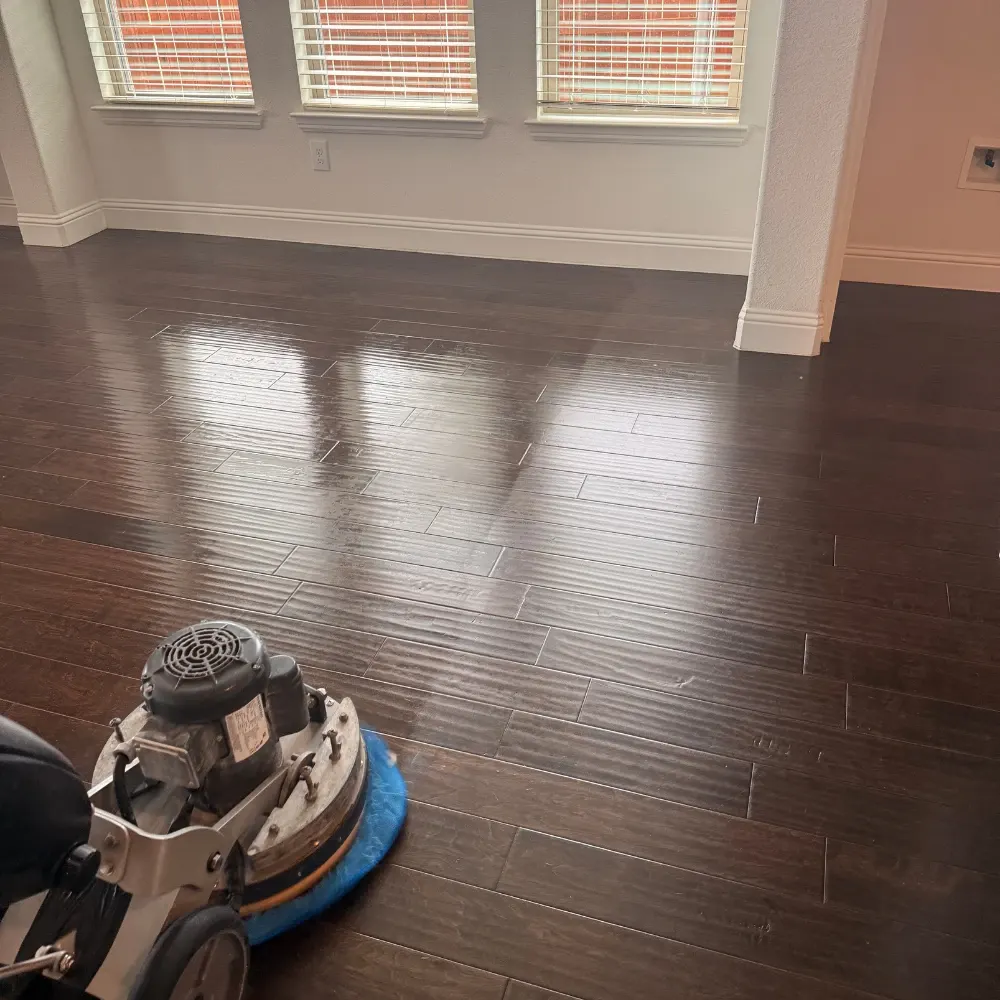
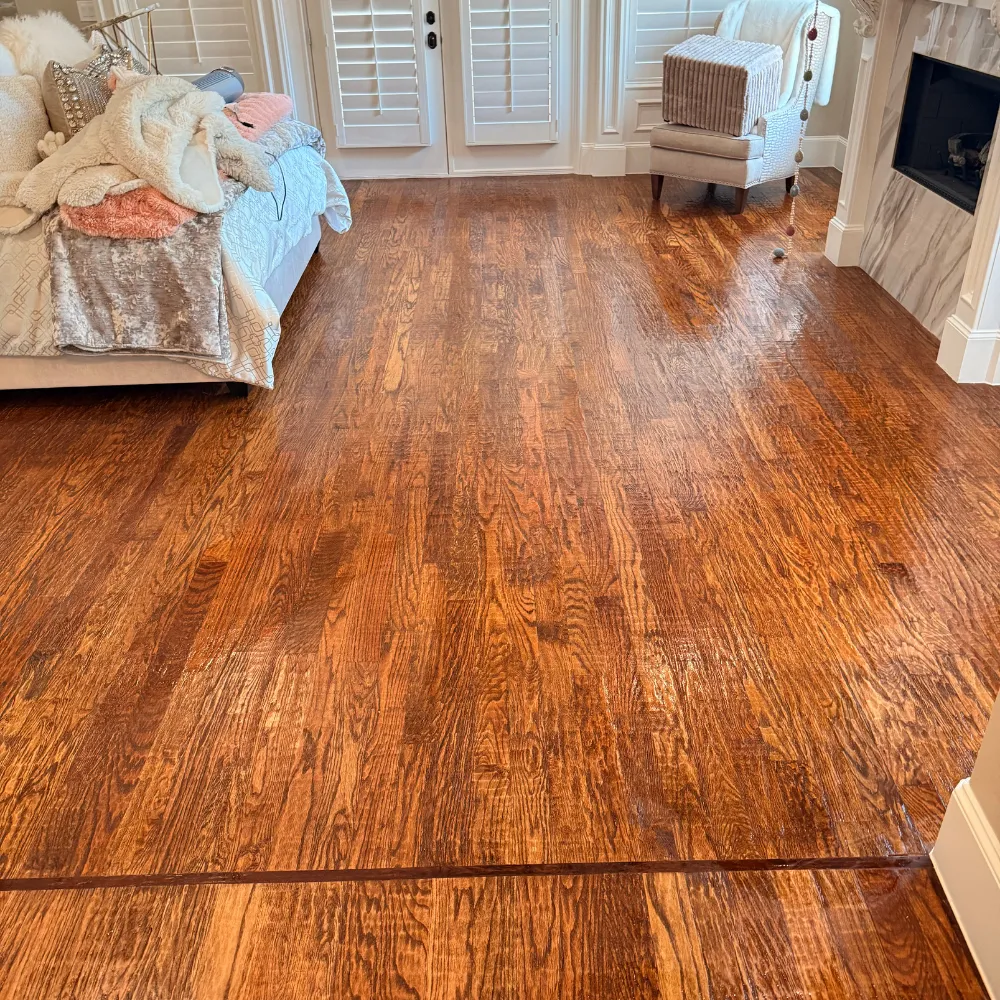
This is the job in the video below. After painters finished in a Colleyville home, the hardwood, including hand-scraped boards, was covered in fine dust. We deep-cleaned and buffed the floors, and the rooms by the pool windows came back to a clean, warm sheen. Hand-scraped and wire-brushed floors hold more dust than smooth boards because of the grooves, which is why a floor machine works better here than a mop.
If you're planning work on the house, book the floor cleaning for after the last trade leaves, not before. Cleaning between crews usually means paying for it twice.
Cause 6: moisture in or under the finish
White rings and cloudy patches that don't wipe off are often moisture that got into the finish. Common spots are under a potted plant, by a pet water bowl, in front of the sink or dishwasher, at an exterior door, or anywhere a steam mop was used regularly. The haze is in the finish, not on it, so cleaning won't change it.
Whether a white mark can be fixed depends on how deep the water went, and a hardwood flooring pro is the right person to judge that. If the boards around the mark are dark, cupped, raised at the edges or soft, the water reached the wood, and that needs a hardwood flooring pro, sometimes along with a check for the leak that caused it.
The NWFA advises wiping spills up quickly and steering clear of wet and steam mops for exactly this reason. Put a tray under plant pots, a mat under the pet bowl and a mat at each exterior door.
Is it cloudy, or is the finish just worn?
A worn finish gets mistaken for haze all the time. Worn floors look dull and gray in the walking paths, in front of the sofa, at the bottom of the stairs and by the kitchen sink, while the corners and the floor under rugs still shine. That's not a film. The clear coat has thinned in those spots.
Cleaning and buffing makes a worn floor look cleaner and more even, but it doesn't add finish back. If the dull paths bother you, the next step is a screen and recoat by a hardwood refinishing pro, which adds a fresh protective coat. If the finish has worn through to bare, gray wood, or there are deep scratches and gouges, the floor needs a sand and refinish.
- Haze across a whole room, smears, footprints: something on the finish. Usually cleanable.
- Dull, gray walking paths with shiny corners: worn finish. Recoat by a refinishing pro.
- Bare wood, deep scratches, gouges: damaged finish and wood. Sand and refinish.
- Dark, cupped or soft boards: water damage. A flooring pro, and find the leak.
What a professional hardwood cleaning and buff fixes
Our hardwood cleaning is a deep scrub, clean and buff for finished hardwood and LVP. It takes off what sits on the finish and leaves no residue behind. Here's how each visit goes:
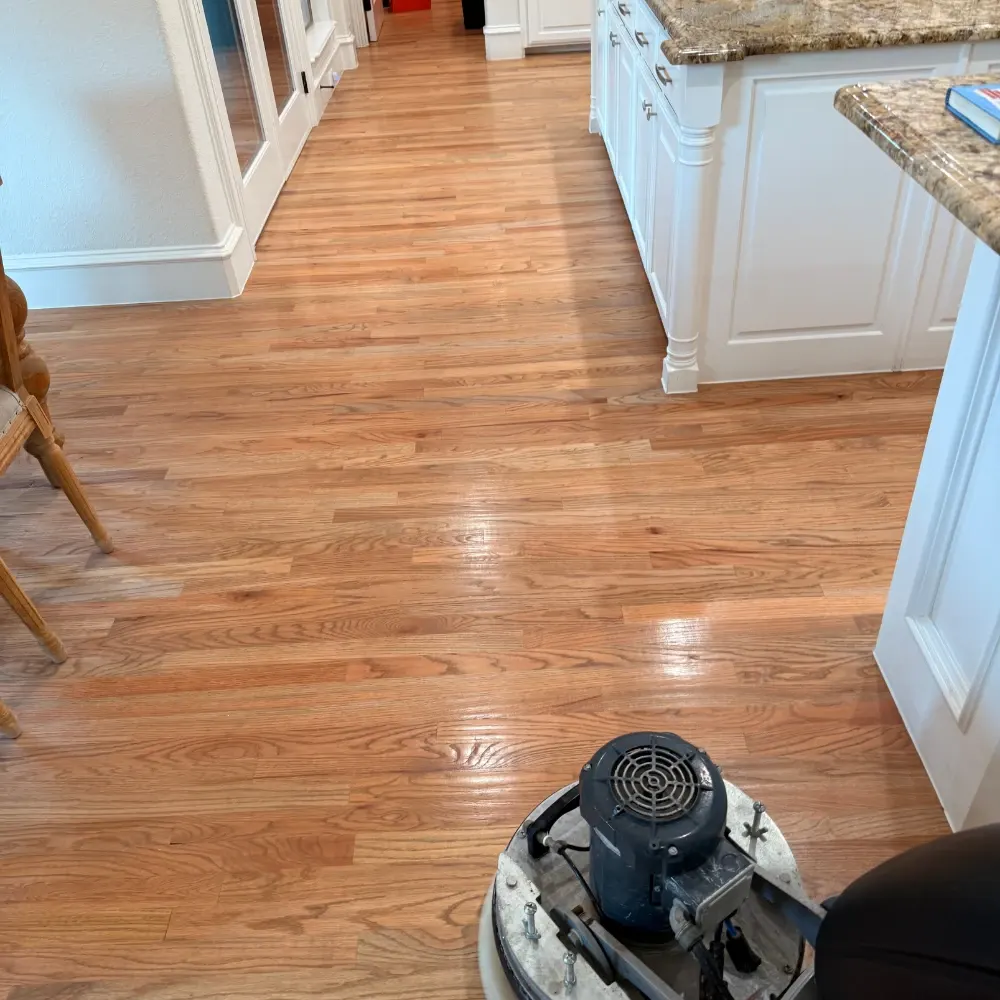
- Floor check: every cleaning starts with a look at the finish and its condition, since different finishes need different care. This is where we'll tell you if the haze looks like wax, polish or wear that cleaning won't fix.
- Dry soil first: dust, dirt and grit come off before any cleaning solution, so nothing scratches the floor.
- Deep scrub: a cleaning solution made for hardwood lifts grime and residue, and the floor machine works it out of the grain and seams. Walkways and entries get extra attention.
- No soaking: hardwood never gets flooded with water.
- Buff: buffing brings back the floor's natural sheen, without leaving residue or streaks.
- Walk on it right away: floors are safe to walk on as soon as we finish.
What hardwood cleaning costs at Hank's
Hardwood and LVP cleaning is $0.60 per square foot with a $400 minimum before 8.25% Texas sales tax. The minimum covers up to about 667 square feet. You can see your exact price and book online with the form at the bottom of this page.
Here are some examples, figured the same way our booking form prices them:
Hardwood floor cleaning prices
- Up to 667 sq ft: $400 ($433.00 with tax).
- 800 sq ft: $480 ($519.60 with tax).
- 1,000 sq ft: $600 ($649.50 with tax).
- 1,500 sq ft: $900.
- 1,000 sq ft of hardwood plus 3 carpeted rooms: $750. When other services in the visit come to more than $210, each carpeted room is $50 instead of $70.
Should you try to fix cloudy hardwood yourself first?
Yes, for the causes that sit on top of the finish, and it costs little to try. Here's a sensible order that won't make anything worse:
- Stop using any product that says polish, restore, shine, revive or wax, and any all-purpose or tile cleaner.
- Dry-clean first: a microfiber dust mop or a vacuum on the bare-floor setting, so grit doesn't scratch while you clean.
- Clean one room with a hardwood cleaner made for your finish, misted lightly on a damp microfiber pad. Change pads as they get dirty.
- Dry-buff the area with a clean, dry microfiber pad right after.
- Look across the room toward a window. Clearer? It was residue, and a few weeks of the right routine may finish the job. No change? The haze is a coating or in the finish.
Home remedies that can make cloudy floors worse
Plenty of online fixes for hazy floors add a new problem. These are the ones to skip on finished hardwood:
- Another coat of polish or a "restorer". It adds to the layer that's causing the haze. The NWFA notes that finishes won't bond over acrylic polish later.
- Wax on a surface-finished floor. The NWFA says not to.
- Steam mops and soaking-wet mops. The NWFA warns they damage the finish and the wood over time.
- Vinyl and tile cleaners. The NWFA says not to use them on wood.
- Ammonia, strippers, strong solvents or abrasive pads, unless the flooring maker's instructions call for them. Hardwood Floors Magazine warns that stripping products can damage the floor, and some finishes for good.
- Mixing products. Two products that are each fine on their own can leave a worse film together.
What we see on cloudy floors around DFW
When a customer texts us photos of a cloudy floor, the story usually lands in one of three places. A floor that's been mopped with an all-purpose product for a year or two, which cleans up well. A home after painting or a remodel, like the Colleyville job above, which cleans up well too. Or a floor with a past of polish or wax, which we send to a refinishing pro.
Hand-scraped and wire-brushed hardwood is common in DFW homes from Southlake to north Fort Worth, and it's the style where residue and dust hide best. The grooves hold film that a flat mop pad slides over, which is why those floors often look cloudy even when the owner cleans them every week. A floor machine reaches into the texture in a way a mop can't.
Engineered hardwood is common in newer homes too. It looks and cleans like solid wood, but its top layer of real wood is thinner, so it has less room for sanding later. That's one more reason to keep polish off it: Hardwood Floors Magazine notes that an engineered floor with a thin wear layer may need replacing if polish has to come off.
How to keep hardwood from going cloudy again
Once the floor is clear, the routine matters more than the product. The NWFA's homeowner schedule is a good base:
National Wood Flooring Association: Wood floor care schedule
- Daily, or as often as you can: sweep or use a soft microfiber dust mop.
- Weekly: vacuum on the bare-floor setting.
- Monthly: clean with a product made for your floor's finish, on a damp pad, not a wet one.
- Never: wax, polish, restorers, oil soaps, steam mops or vinyl and tile cleaners on finished hardwood.
- Always: felt pads under chair and table legs, mats at exterior doors, a tray under plant pots, and spills wiped up right away.
- When it looks tired: a professional deep clean and buff brings the sheen back without adding anything to the finish.
Does LVP get cloudy for the same reasons?
Mostly, yes. Luxury vinyl plank gets the same residue film from the wrong cleaner or too much product, and the same gray look after construction dust. The textured, wood-look surface on many LVP floors holds film just like hand-scraped hardwood. We clean LVP with the same deep scrub, at the same $0.60 per square foot with a $400 minimum, and hardwood and LVP in the same visit are priced together.
Check your LVP maker's care instructions before putting any shine product on it. If a past owner used one and the floor has gone hazy, the same rule applies: stop using it before anything else.
Not sure which cause you have? Send us photos
Text two or three photos to (817) 697-7500: one looking across the floor toward a window, one close-up of the haziest spot and one of a corner or the floor under a rug for comparison. Tell us what you clean with and whether there's been any painting or remodeling. We'll tell you honestly whether it's something our cleaning and buff will fix or a job for a hardwood refinishing pro.
If it's cleanable, you can see your price and book online with the form at the bottom of this page, or call us. Hank's Carpet Cleaning is a family-owned company based in Argyle with an office in Southlake, with 400+ five-star reviews and a 30-day satisfaction guarantee. We clean hardwood floors across DFW, including north Fort Worth, Southlake, Keller, Colleyville, Grapevine and Flower Mound.
Hardwood floor cleaning in north Fort Worth · Hardwood floor cleaning in Southlake