

Carpet cleaning guide · Published November 22, 2026
The short answer: often yes, if the treatment reaches the pad
Carpet with pet urine in the pad can often be saved. Hank's Carpet Cleaning treats urine at the source, down through the carpet into the pad; in a Justin rental we extracted it from the subfloor. Pad that's been soaked over and over, crumbles, or sits on a stained subfloor usually needs replacing by a carpet installer.
The rest of this guide helps you work out which group your carpet is in before you spend money on it. Start with the quick decision list, then read the section that matches what you see and smell. If you'd rather just ask, text a few photos and a short description to (817) 697-7500, and we'll tell you honestly what cleaning can do.
Saved, maybe, or replace? A quick decision list
These are the patterns we see on pet jobs around DFW. They're a starting point, not a promise: the tech checks the carpet in person before we start, and tells you what to expect.
- Fresh accident, found within a day or two, one spot: almost always saved. Blot it now (steps below), then treat it at your next cleaning.
- A few old spots in one room, smell only when you get close: usually saved. A targeted spot treatment plus an enzyme treatment on those areas is the normal fix.
- Smell that comes back on humid days, or stains that reappear after cleaning: urine is in the pad. Often saved with treatment that reaches the pad, but plan for a second treatment on the worst spots.
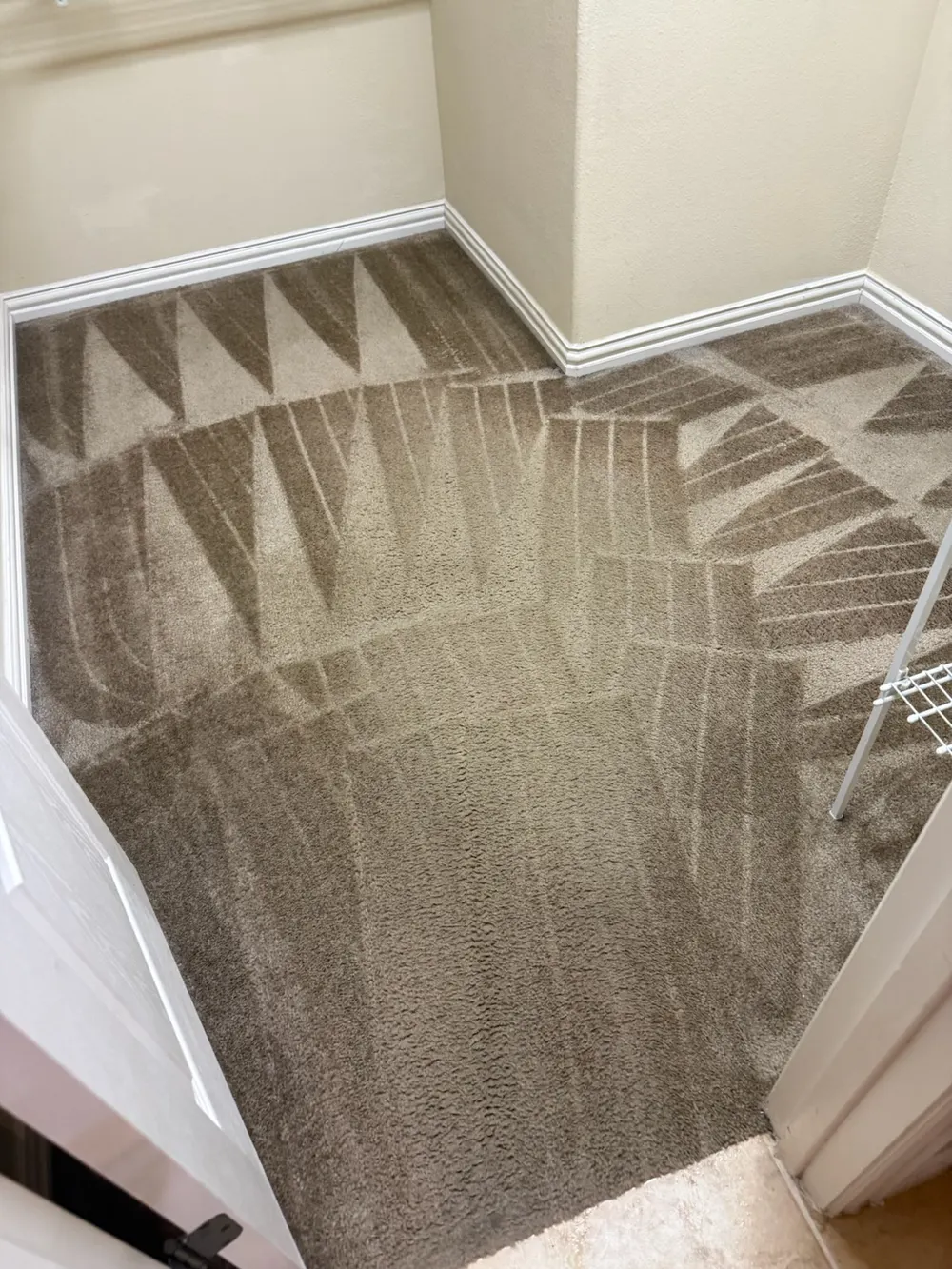
- Urine soaked through a closet, a corner or a whole room: sometimes saved. It depends on how deep it went; in the Justin closet we had to extract urine from the subfloor itself.
- Pad that feels crunchy or crumbles, a smell you notice from the doorway after cleaning, seams lifting, or a dark stain on the wood or concrete underneath: the pad needs replacing by a carpet installer, and the subfloor may need treatment before new pad goes down.
- Carpet that's turned yellow, orange or pink where the urine sat: the odor can usually be treated, but the color change is often permanent dye damage.
Why urine ends up in the pad, not just the carpet
Wall-to-wall carpet is three layers on top of your floor: the fibers you see, a backing that holds them in place, and a foam or fiber cushion (the pad) underneath. Most household carpet isn't built to stop a liquid. A dog or cat accident runs straight through the fibers and backing and spreads out in the pad, which soaks it up like a sponge. The wet spot underneath is often a lot bigger than the spot you can see on top.
The Carpet and Rug Institute, the carpet industry's trade group, says this in its technical bulletin on pet urine: some carpet makers build backings that resist spills and keep them from reaching the cushion and "perhaps, the subfloor." That's the exception, which is why most pet urine problems are really pad problems.
The same bulletin explains why some accidents are easy and some aren't. Urine changes with a pet's diet, medications, age, health, sex and reproductive cycle, so two accidents on the same carpet can behave differently. It also says some urine spots show up right away, while others take weeks or months to react with the carpet dye.
Carpet and Rug Institute: Pet Urine and Carpet (technical bulletin)
How do you know if urine soaked into the pad?
Urine has probably reached the pad if the smell comes back on humid or rainy days, a stain reappears a few days after you cleaned it, or the smell gets stronger when you press down on the spot. Here's what each clue tells you:
- The smell comes and goes with the weather. The Carpet and Rug Institute says some odor products only mask the smell, and "in times of high humidity, the odor may reappear." A smell that returns on a muggy day means urine is still in the carpet or pad, not on the surface.
- The stain comes back after you clean it. As carpet dries, moisture moves up through the fibers and can carry what's in the pad back to the top. This is called wicking (or wick-back), and it's the clearest sign that the source is below the carpet.
- Pressing on the spot makes it smell. Push down firmly with a paper towel, then lift it and smell it. If the towel smells of urine, or comes up damp or yellow, there's urine in the pad.
- The carpet feels stiff or crunchy, or the floor feels uneven. Dried urine leaves residue behind. A pad that's been soaked many times can also break down and feel lumpy or flat underfoot.
- Seams are lifting or the carpet is coming apart. The Carpet and Rug Institute says moisture from urine can weaken the bond between the carpet's layers and cause the backing to separate, and seams are especially vulnerable.
- You smell it from the doorway. A room that smells of urine before you walk in usually has more than a spot or two, and a good share of it is in the pad.
Dog urine vs cat urine: does it matter?
It matters most for odor. The Carpet and Rug Institute calls out cat urine specifically: "Unless the cat urine can be completely removed, complete odor removal is unlikely." Cats also often go back to the same corner or closet, so one cat spot is often a dozen accidents in the same place, each one soaking a little deeper.
Dog accidents tend to be bigger and spread out more, which means a wider wet area in the pad, but they're often found faster. A puppy that's still learning usually leaves fresh spots in the rooms where it spends time; an older dog may leave the same spot over and over without anyone noticing until the smell builds.
Either way, the fix is the same idea: get treatment down to where the urine actually is, not just onto the fibers on top. Ask us when you book if you have a mix of pets or you're not sure which one is the culprit; it doesn't change the price, but it helps the tech plan.
What can professional cleaning do for urine in the pad?
Professional cleaning removes the urine itself, not just the smell on top, and that's what decides whether the pad can stay. At Hank's Carpet Cleaning, every pet job follows the same order:
1. Find the spots and check how far they go
Tell us about pet accidents when you book (there's a box for it in the online quote builder). The tech walks the rooms with you, finds the spots, and checks which ones have gone through to the pad. You hear what we think cleaning can and can't do before we start, including any spots where the color has already changed.
2. Targeted spot treatment on every accident
Pet accidents get a targeted spot treatment as part of the cleaning, at no extra charge. Stains are included in the cleaning price.
3. An enzyme treatment where the urine went deep
For stronger odor and urine in the pad, we offer an enzyme treatment on the affected areas. The enzymes break down the odor source so it doesn't keep coming back when the weather turns humid. It's optional: the tech recommends it only where it's needed, and you approve it on site before we add it.
4. The right cleaning method for the job
Our main carpet method is low-moisture cleaning, which doesn't soak the carpet or the pad. That matters on pet jobs: an over-wet cleaning can push water into the pad and bring back a wet-dog smell. Carpet cleaned this way is usually dry in about an hour.
When a carpet needs a deeper rinse, the tech uses truck-mounted hot-water extraction instead (also on request). It takes longer to dry. In the Justin closet below, getting the urine out of the subfloor took extraction under the carpet, not just cleaning on top of it.
5. A deodorizer to finish
Every cleaning includes a free deodorizer. On its own, a deodorizer only freshens. It's the last step after the urine itself has been treated, never a replacement for it.
What the cleaning standard says (and doesn't)
The carpet cleaning industry's main standard is ANSI/IICRC S100, the Standard for Professional Cleaning of Textile Floor Coverings, published by the Institute of Inspection, Cleaning and Restoration Certification. The current edition (the seventh, 2021) covers cleaning chemistry, carpet construction, pre-cleaning and post-cleaning inspections, spot and stain removal, residential cleaning and area rugs.
Two parts of it line up with what you should expect on a pet job. First, an inspection before cleaning: someone should look at the carpet with you and set expectations before anything gets wet. Second, spot and stain removal as its own step, not a pass of the machine over the top. If a company can't tell you how it handles urine below the surface, ask before you book.
IICRC: ANSI/IICRC S100 Standard for Professional Cleaning of Textile Floor Coverings
When does the pad have to be replaced?
Replace the pad when it's been soaked so many times that treatment can't reach all of the urine, or when the pad itself is breaking down. Cleaning works on carpet and on the urine inside it; it can't rebuild foam that's crumbling or undo a stain that's gone into the wood or concrete underneath.
These are the signs that a section of pad needs to come out:
Who replaces pad?
A carpet installer. Replacing pad means pulling the carpet back, cutting out the bad section, dealing with the subfloor under it and stretching the carpet back into place. A flooring pro can also tell you whether the subfloor needs to be treated before new pad goes down.
Often it's only a section: a closet, a corner or a strip along one wall. The rest of the room's pad is fine and the carpet on top can still be cleaned. Once new pad is in, a cleaning freshens the whole room so the repaired area doesn't stand out.
- The pad is crumbly, flattened or lumpy under the urine area.
- The smell is still strong after a professional cleaning plus an enzyme treatment, and returns within days.
- The subfloor (plywood or concrete) under the spot is dark, stained or smells when the carpet is pulled back.
- The carpet's backing has separated, or seams in the area are coming apart.
- A whole room or closet has been used as a litter area for months.
Will the stain come back? Our re-clean rule for wick-back
Sometimes, and we cover it. A spot that looked gone the day of the cleaning can show up again a day or two later as the carpet dries and moisture pulls what's left in the pad up to the surface. If a spot wicks back after we clean it, we come back and re-clean it for free under our 30-Day Happiness Guarantee: if anything we cleaned isn't right within 30 days, we re-clean it, as many times as it takes to get it clean.
The guarantee covers the areas we cleaned. It doesn't cover permanent damage that cleaning can't reverse, like dye stains, or new accidents after the appointment. Your tech points out anything like that before we start, so there are no surprises.
Can urine stains be removed if the color changed?
The smell often can be; the color often can't. The Carpet and Rug Institute says urine can affect carpet dyes, "although not all occurrences will result in a permanent stain." When spots develop slowly and are found long after the accident, it says, the dyes and fibers "may be permanently damaged."
It also explains the strange colors people see. In beige carpet, urine attacks the blue dye and leaves the red and yellow behind, so old spots look red, yellow or orange. Cleaning can lighten that kind of spot, but it can't put the blue dye back. We tell you before we start if a spot looks like dye damage instead of a stain.
What to do right now if you just found a urine spot
Blot it, rinse it gently and don't over-wet it. This is the Carpet and Rug Institute's own method, shortened:
What not to do
Don't scrub, which spreads the spot and frays the fibers. Don't soak the spot with a rental machine or a big pour of cleaner, which drives the urine down into the pad. And don't count on a fragrance spray: the Carpet and Rug Institute warns that some odor products simply mask the smell, which then comes back in humid weather. If the spot is still there or the smell comes back, that's the time to book a professional cleaning.
- Blot the damp area right away with plain white paper towels. Press, don't rub.
- Mix 1/4 teaspoon of liquid dishwashing detergent (non-bleach, non-lanolin) in 1 cup of lukewarm water. Don't use automatic dishwasher detergent or laundry detergent.
- Wet paper towels with the solution and blot the spot. Absorb with dry towels, rinse with warm water, and repeat as long as the spot keeps transferring to the towel.
- Don't over-wet. More water pushes the urine deeper into the pad.
- Follow with 1 cup of white vinegar in 2 cups of water and blot dry.
- Lay a half-inch stack of paper towels on the spot, weigh it down with something flat and heavy that won't bleed color, and change the towels until the carpet is dry.
Real pet urine jobs we've done
These are real Hank's jobs with pet urine in the pad. We don't share customer names or addresses, but the work is exactly as described.
A same-day rental move-in in Justin
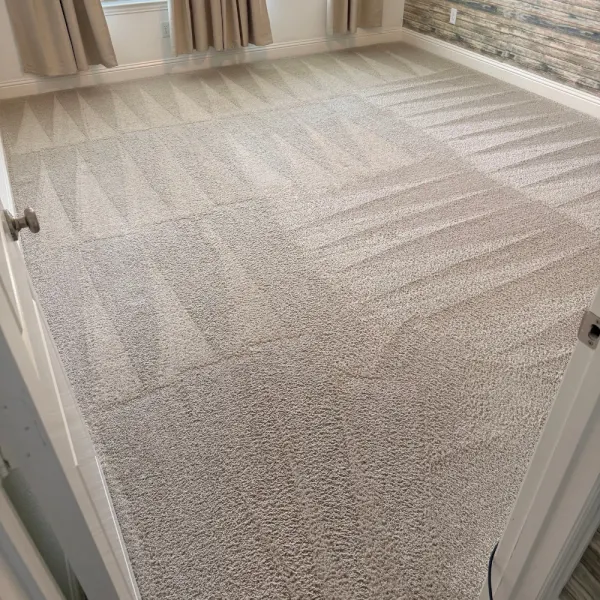
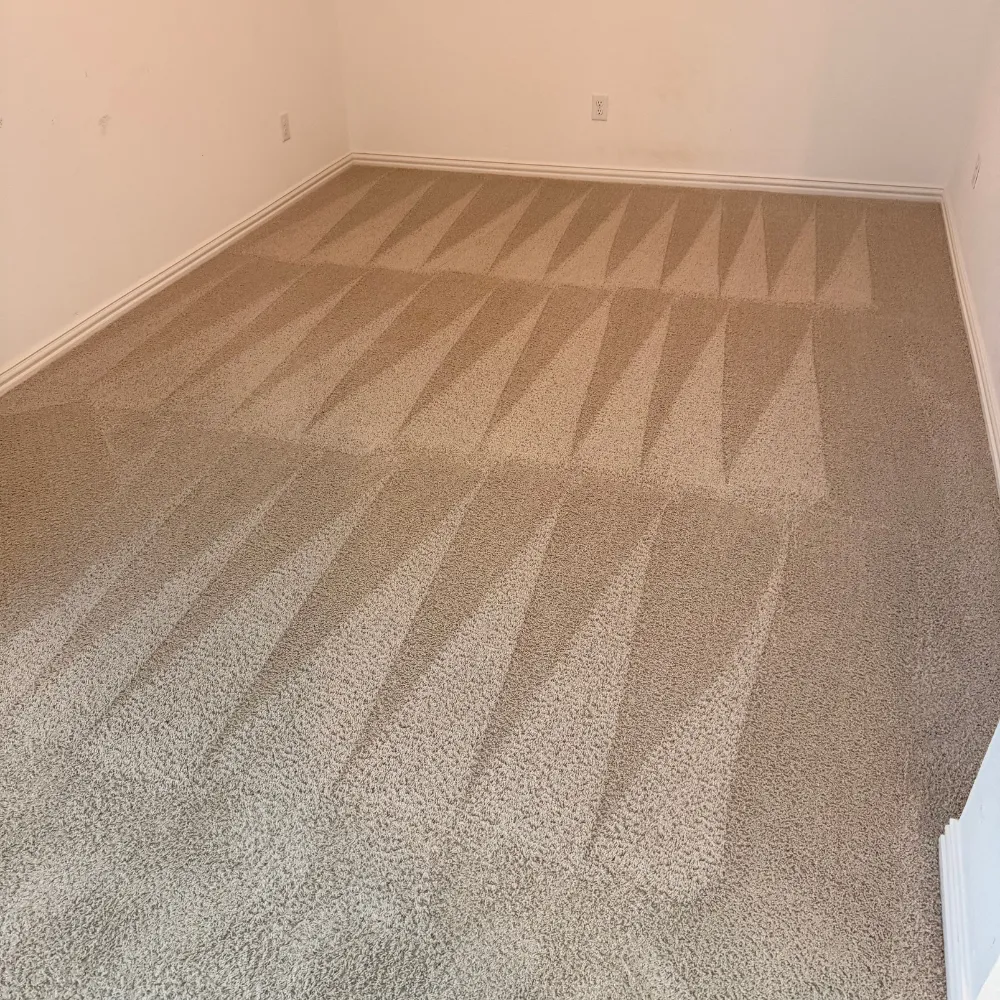
A tenant moving into a rental home in Justin needed the carpets cleaned the same day, after the cleaning they'd been promised fell through. We cleaned two bedrooms, the game room, the master closet and the stairs that afternoon. Pet urine had soaked into most of the rooms, so we treated every affected area. In the master closet, it had gone all the way through, so we extracted the urine from the subfloor underneath the carpet. That's the closet in the photo at the top of this page, finished in one visit.
Pad soaked across the upstairs in north Fort Worth
A family in north Fort Worth booked two rooms and a closet, plus a pet enzyme treatment for one bedroom and the couch. Once we were on site, we found urine had soaked into the pad across the upstairs rooms, including the guest bedroom and walk-in closet. With the family's OK, we added the staircase and hallway, treated the affected areas with an enzyme urine treatment and a deodorizer, and cleaned the couch. This is a common pattern: the room you know about isn't the only one.
A vacant home before a closing in Keller
A homeowner booked carpet cleaning for a vacant house ahead of a closing. Our tech let himself in with the lockbox and cleaned six rooms, the staircase, a hallway and the master closet. Once we were on site, the homeowner added two more rooms and a pet odor enzyme treatment in three of them, approved by text. Everything was finished the same afternoon, and we texted photos of the clean carpet so the house could be checked without a drive over.
Moving in, moving out or selling with pets
Empty rooms are when pad problems show up. Furniture comes out, the spot behind the couch or in the closet is suddenly in plain view, and a room that smelled fine with the windows open smells different once the house is shut up. Two of the three jobs above were move-ins or a sale.
If you're moving out of a rental, selling, or moving into a home that had pets, book the cleaning for after the furniture is gone and tell us about pets when you book. You don't need to be home: many customers leave a gate code, key or lockbox code, and we can text photos when we're done. If the tech finds a spot that's gone through to the subfloor, we'll tell you right away, so you can decide on treatment or a pad repair before anyone else finds it.
We clean for homeowners, renters and property owners in Roanoke, Justin and across DFW.
How much does it cost to treat pet urine in carpet?
At Hank's Carpet Cleaning, pet spot treatment and the deodorizer are included in the regular carpet price: 3 rooms are $210 before tax ($227.33 with 8.25% Texas sales tax), and the online quote builder shows your exact total. The enzyme treatment for urine in the pad is an optional add-on the tech prices on site, and you approve it before we start.
Here's what common pet jobs cost for the cleaning itself, before tax:
What isn't in that price
The enzyme treatment, priced on site by area. Pad replacement and subfloor repair, which are carpet installer work. Ozone treatments, which we don't offer. Ticking the pet accidents box in the quote builder doesn't change the price; it just tells the tech to come ready.
- 1 to 3 rooms: $210 (the $210 visit minimum covers 3 rooms)
- 4 rooms: $260
- 5 rooms: $310
- 3 rooms + staircase + hallway: $295
- 4 rooms + staircase + hallway + master closet: $370 ($400.53 with tax)
- Each staircase $60, hallway $25, master closet $25, area rug $60
How to keep it from happening again
Catch new accidents early, and find out why they're happening. A spot found in an hour is a towel job; a spot found in a month is a pad job.
- Blot new accidents right away using the steps above, before they reach the pad.
- Check the usual hiding places every week or two: closets, corners, behind furniture and under beds.
- If a house-trained pet starts having accidents, ask your vet. The Carpet and Rug Institute notes that urine changes with a pet's health and medications, and a change in habits can be a health sign too.
- Treat the old spots properly. A pet goes back to a spot that still smells to it, even if you can't smell it.
- Replacing carpet? The Carpet and Rug Institute says some carpet makers offer backings that keep spills from reaching the cushion. Ask your carpet dealer about them.
- Get carpet cleaned regularly. Many carpet makers recommend professional cleaning every 12 to 18 months, and homes with pets often benefit from more often.
Not sure if your pad can be saved? Send us photos
Text two or three photos to (817) 697-7500: one of the room, one close-up of the worst spot, and one of the carpet pulled back at a corner if you can do that safely. Tell us what kind of pet, how long it's been going on, and whether the smell gets worse on humid days. We'll tell you honestly whether it sounds like a cleaning, a cleaning plus enzyme treatment, or a pad repair for a carpet installer.
If it's a cleaning, you can see your price and book online with the form at the bottom of this page. Hank's Carpet Cleaning is a family-owned company based in Argyle with an office in Southlake, voted Best of Fort Worth 2025 and 2026, with 400+ five-star reviews and a 30-day satisfaction guarantee. Our products are safe for kids and pets once dry.
Carpet cleaning in DFW · Can carpet cleaning remove pet stains and odors?