


Grout color sealing guide · Published November 23, 2026
The short answer: grout cracks when the floor moves and the grout can't
Grout cracks because it's rigid and the floor under it isn't. In DFW the usual causes are slab movement from clay soil that swells when wet and shrinks when dry, missing movement joints at walls, a floor that flexes, or grout mixed with too much water. Hank's Carpet Cleaning cleans and color seals grout, but cracks that keep growing need a tile or foundation pro first.
That's the honest version, and it matters, because a crack is a symptom, not the problem. Fill or seal over a crack that's still moving and it usually cracks again in the same place. Find out why it cracked, and you'll know whether you need a cleaning, a small repair, a regrout or a call to someone who works on foundations.
This guide walks you through it in order: how to read the crack pattern, what clay soil does to a slab, the other common causes, which fixes work for which kind of crack, and where grout cleaning and grout color sealing fit in. We clean tile and grout for a living. We don't inspect or repair foundations, and nothing here is foundation advice.
Read your cracks: a quick pattern guide
Before you call anyone, walk the floor and look at where the cracks are and what shape they take. The pattern points to the cause far better than the age of the grout does.
- Hairline cracks scattered all over, in short random lines, often within the first months: usually shrinkage. The grout was mixed with too much water or dried too fast.
- Cracks along the walls, at the base of cabinets, around a kitchen island or where tile meets a doorway: usually missing perimeter or transition joints. The grout is jammed against something that moves differently from the floor.
- A crack that runs in a long, fairly straight line across the room, through grout AND tile: something underneath moved. Often it follows a crack in the concrete slab below.
- Cracks in one area that keep getting wider, with tiles that sound hollow when you tap them: the tile is coming loose from the floor. That's a tile repair, not a grout problem.
- Cracks that open in late summer and close up again in a wet spring, or a door nearby that sticks some months and not others: seasonal movement. In DFW, that points to the soil under the slab.
- Grout that's crumbling or powdery rather than cracked: often a weak mix or years of harsh cleaners. That's a regrout candidate in the worst areas.
Why does grout crack in DFW homes? The clay soil under the slab
Much of DFW is built on clay soil that changes volume with moisture. When it gets wet it swells, and when it dries out it shrinks. Most homes here sit on a concrete slab poured on that soil, so as the ground moves through the seasons, the slab can move with it, and tile glued to the slab feels every bit of that.
The Texas Department of Licensing and Regulation puts it plainly in its technical bulletin on foundations: expansive soils, "soils that shrink and swell due to changes in moisture content, are a very common cause of foundation problems." The same bulletin explains that wet expansive soils heave and lift a building, while dry ones shrink and let it settle, and that "both can cause extensive damage to buildings."
The best-known example of this soil is Houston Black clay. A USDA Natural Resources Conservation Service fact sheet describes it as covering about 1.5 million acres of the Blackland Prairie, "which extends from north of Dallas south to San Antonio," and calls these soils the classic example of soils that "shrink and swell markedly with changes in moisture content." It also notes that in metro areas, their "very high shrink-swell potential commonly is a limitation affecting building site development."
Soil changes from one neighborhood to the next, and not every DFW home sits on Houston Black. If you want to know what's under your own lot, the free NRCS Web Soil Survey lets you draw your property on a map and read the soil type. TDLR's bulletin points builders to the same tool.
Texas Department of Licensing and Regulation: Foundations on Expansive Soils (IHB TB 10-01) · USDA NRCS: Houston Black, Texas State Soil (fact sheet) · USDA NRCS Web Soil Survey
How does slab movement show up in your grout?
Grout is a cement product. It's strong when you press on it and weak when you pull it apart. Tile is stiff too. When a slab bends or shifts even a little, the stress has to go somewhere, and the grout joint is the weakest line in the floor, so that's where it shows first.
That's why slab movement tends to leave long cracks that line up across several tiles, sometimes stepping from joint to joint, and sometimes cracking a tile in half where the slab crack runs underneath. Short random hairlines in the middle of the room are a different problem (see shrinkage below).
The seasonal pattern is the giveaway. TDLR's bulletin says the amount of swelling a clay can do is partly a function of regular changes in the soil's moisture content. In practice that means homeowners often notice new grout cracks after a long dry summer, or after a big change in how the yard is watered, more than at any other time.
Is cracked grout a sign of foundation problems?
Sometimes, but not usually on its own. Most grout cracks we see come from shrinkage, missing movement joints or ordinary seasonal movement, not from a foundation that needs repair. A crack only tells you something moved, not how much or whether it's still moving.
What we can tell you is when a crack doesn't look like a grout problem, because we spend our days on tile floors: long cracks running through tiles, cracks that keep widening, tiles that have lifted or sunk, or cracks that line up with trouble elsewhere in the house. When we see those, we'll point them out and suggest you have the house looked at by a qualified foundation professional or structural engineer before spending money on the grout.
We don't inspect foundations, and we won't guess whether yours needs repair. That's a job for someone licensed to answer it. The point of this section is simply that cleaning or sealing grout over an active crack is money spent in the wrong order.
The other common causes of cracked grout
Clay soil gets the blame for a lot in DFW, but plenty of cracked grout has nothing to do with the ground. These are the other causes that come up most, in roughly the order homeowners run into them.
1. Missing or grouted-over movement joints
Tile floors are supposed to have soft joints where they meet walls, cabinets, columns and other materials, and in big rooms, out in the field of the floor too. These joints are filled with a flexible sealant (caulk), not grout, so the floor can expand and contract without pushing against anything hard.
In an article on movement joint standards in Construction Specifier, tile consultant Donato Pompo summarizes the Tile Council of North America's guidance: movement joints in interior tile every 20 to 25 feet in each direction, every 8 to 12 feet where tile is exposed to sunlight or moisture, and at "all transitions of planes or different materials." He also notes that "tiles at perimeters of rooms should have movement joints."
When that joint was grouted solid, or never left at all, the grout at the wall takes the stress and cracks. That's why so many grout cracks run along baseboards, cabinet toe kicks and sunny patio doors. Sunlight matters in DFW: a tile floor in front of a west-facing glass door can heat up a lot more than the rest of the room.
2. Temperature and moisture movement
Tile, the mortar under it and the slab all expand and contract with heat and moisture, and not at the same rate. Pompo lists thermal or moisture movement, shrinkage and structural movement as the forces movement joints are there to absorb. Without somewhere for that movement to go, the grout is what gives.
3. Shrinkage from the original install
Grout that was mixed with too much water, or dried too fast, shrinks as it cures and leaves hairline cracks. This usually shows up in the first months after installation, in random short cracks or grout pulling away from the tile edges. It's an installation problem, not a soil problem, and it doesn't usually keep getting worse.
4. A floor that flexes
Tile on a wood subfloor, like an upstairs bathroom or laundry room, cracks when the floor underneath bends under load. Grout cracks in a line, often where people walk most, can mean the subfloor is too flexible for tile. Pompo's article lists deflection of the structure among the movements tile has to survive.
5. Tile coming loose
If a tile sounds hollow when you tap it with a coin or a screwdriver handle, the mortar under it isn't holding. The grout around a loose tile cracks because the tile is rocking. Fixing the grout without resetting the tile doesn't last.
6. Wear, water and harsh cleaners
Grout that's years old, mopped with strong acid or bleach cleaners, or soaked over and over can turn weak and sandy. It tends to crumble and wash out of the joints rather than crack in clean lines. That's a different look, and a different fix.
Cracked grout causes and fixes at a glance
Here's how the causes line up with what actually fixes them, and who does that work.
- Shrinkage hairlines from the install: clean, fill the worst cracks, then seal. A grout cleaning plus grout color sealing handles this well once the cracks have stopped moving.
- Cracks at walls, cabinets and doorways: cut the grout out of that joint and replace it with a flexible sealant. Tile installer work.
- Long cracks through grout and tile from slab movement: have the movement checked first by a foundation professional or engineer, then repair the tile. Clean and seal last.
- Loose, hollow-sounding tiles: reset or replace the tiles. Tile installer work.
- Upstairs floor that flexes: the subfloor needs stiffening before tile repairs will hold. Tile installer or contractor work.
- Crumbling grout across most of the floor: regrout. Tile installer work. Grout color sealing isn't the fix here.
- Sound grout that's only dirty, stained or blotchy: a professional tile and grout cleaning, or grout color sealing for one even color. That's us.
Should you fix cracked grout right away?
Yes, if water gets on that floor. A cracked grout line lets mop water, spills and pet accidents into the joint and under the tile, which can loosen the tile over time and stains the grout from the inside. In a kitchen or laundry room, open cracks also hold dirt you can't mop out.
But fix it in the right order. If the crack is still growing, a repair now will crack again. Mark the end of the crack with a pencil line and a date, and check it again in a few weeks. A crack that hasn't moved past your mark is a good candidate for repair. A crack that has moved needs its cause found first.
If you're waiting to find out, keep the area dry and avoid soaking it while you mop. Don't fill the crack with caulk from the hardware store just to hide it: the caulk holds dirt, it doesn't match the grout, and it has to come back out before any real repair or a color seal.
Can you just put new grout in the cracks?
For a few small cracks that have stopped moving, yes. Patching means scraping out the cracked grout in that joint and packing in new grout. Two catches: new grout almost never matches old grout's color exactly, and a patch in a joint that's still moving will crack again.
When the cracks are spread across the floor, a full regrout is the real fix. That means grinding or raking the old grout out of every joint and grouting the floor again. It's slow, dusty work, and it's a tile installer's job.
A regrout also leaves you with brand-new grout that's going to start soaking up dirt like the old grout did. That's where sealing comes in.
Where grout cleaning and color sealing fit in
Once the floor has stopped moving and any loose tile or failed joints are fixed, the grout usually looks worse than ever: old stained lines, a few patched spots in a slightly different color, maybe fresh caulk at the walls. That's the point where Hank's Carpet Cleaning comes in.
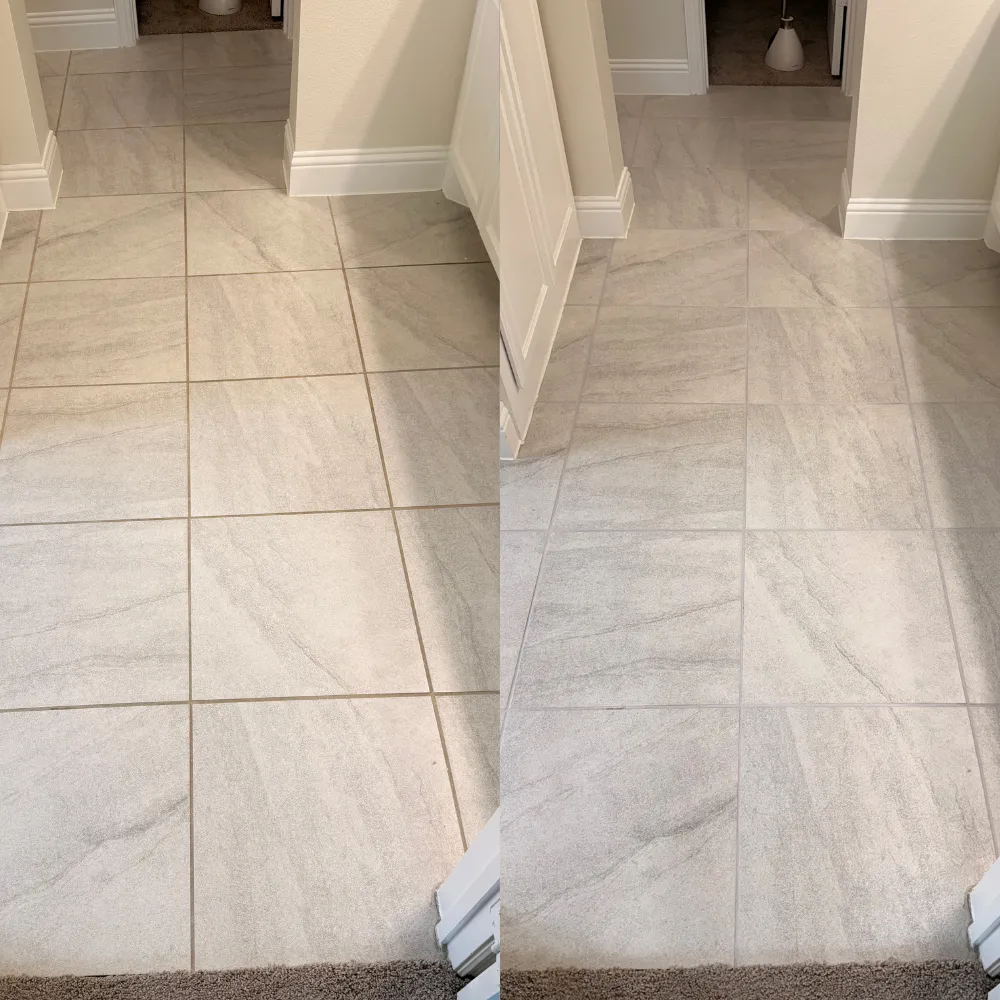
Grout color sealing is our usual answer. We deep-clean the grout first, fill missing grout in spots, and then apply a color sealant by hand, line by line, so the old grout and the patches all end up one even color. It changes grout color without regrouting, it helps the grout resist spills and stains, and it lasts 5 to 10 years for most homes with proper care. Every job comes with a 3-year labor warranty and a touch-up kit. Grout color sealing is for ceramic and porcelain tile.
Grout color sealing starts at $250 for a small or guest bathroom, $300 for a dining room and $400 for a kitchen, with a $500 minimum per visit. Those are starting prices before tax: the tech confirms the final price on site, and cracked or missing grout and other repairs can change it. Color seal jobs book at least 7 days out.
If you like your grout color and it's just dirty, a tile and grout cleaning is the cheaper fix: $0.90 per square foot before tax, with a $500 minimum.
Grout color sealing in DFW · Can you change grout color without regrouting?
What we won't do: seal over a crack that's still moving
No coating holds together a joint that's still moving. If we sealed over an active crack, the sealant would crack with it, and you'd have paid to make a symptom look better for a few months.
So when you send photos for a quote, point out every crack. If the photos show cracks that look like movement (long lines through tile, gaps at walls, tiles that look lifted), we'll tell you before you book, not on the day of the job. On site, the tech checks the floor again before starting and tells you about anything cleaning and sealing won't fix.
Here's what that looks like in a typical text exchange. You send a kitchen photo with grout cracks along the cabinet base. We tell you those look like a missing movement joint at the cabinets, that a tile installer should cut out and caulk that joint, and that the rest of the kitchen grout can be cleaned and color sealed once that's done. No guessing about your foundation, no sealing over a problem.
What a grout job looks like after the cracks are dealt with
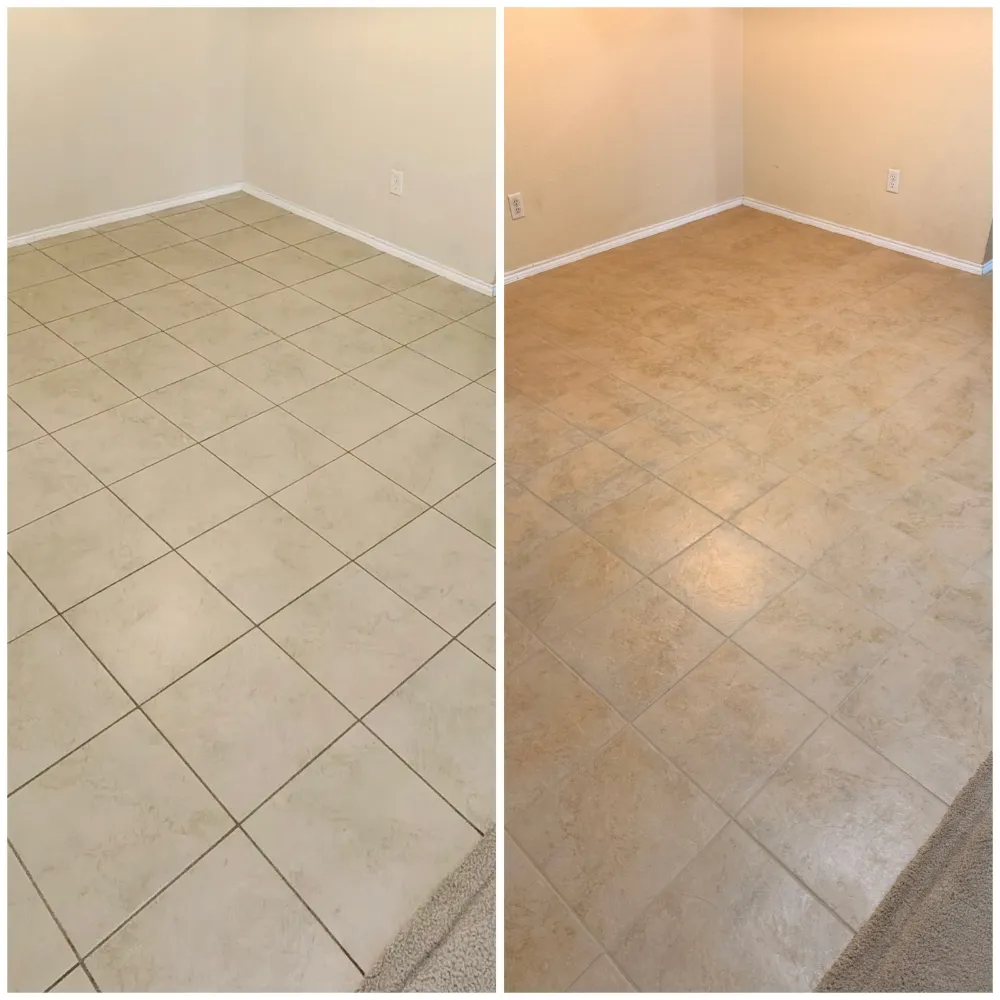
The best time to do it is when a house is empty or about to change hands. In the Flower Mound home above, the owners scheduled grout color sealing for the entry and kitchen before their furniture arrived, so every joint was easy to reach and the whole floor came out one color.
1. Photos and a price
Send photos of each room: one from the doorway and one close-up of the grout, plus a close-up of any crack. Pick a color in the 60-second color quiz on our grout color sealing page or by text. We text back your price.
2. A look at the floor before we start
The tech walks the floor with you, checks the cracked and missing spots you pointed out, and tells you about anything that should go to a tile installer instead.
3. Deep cleaning
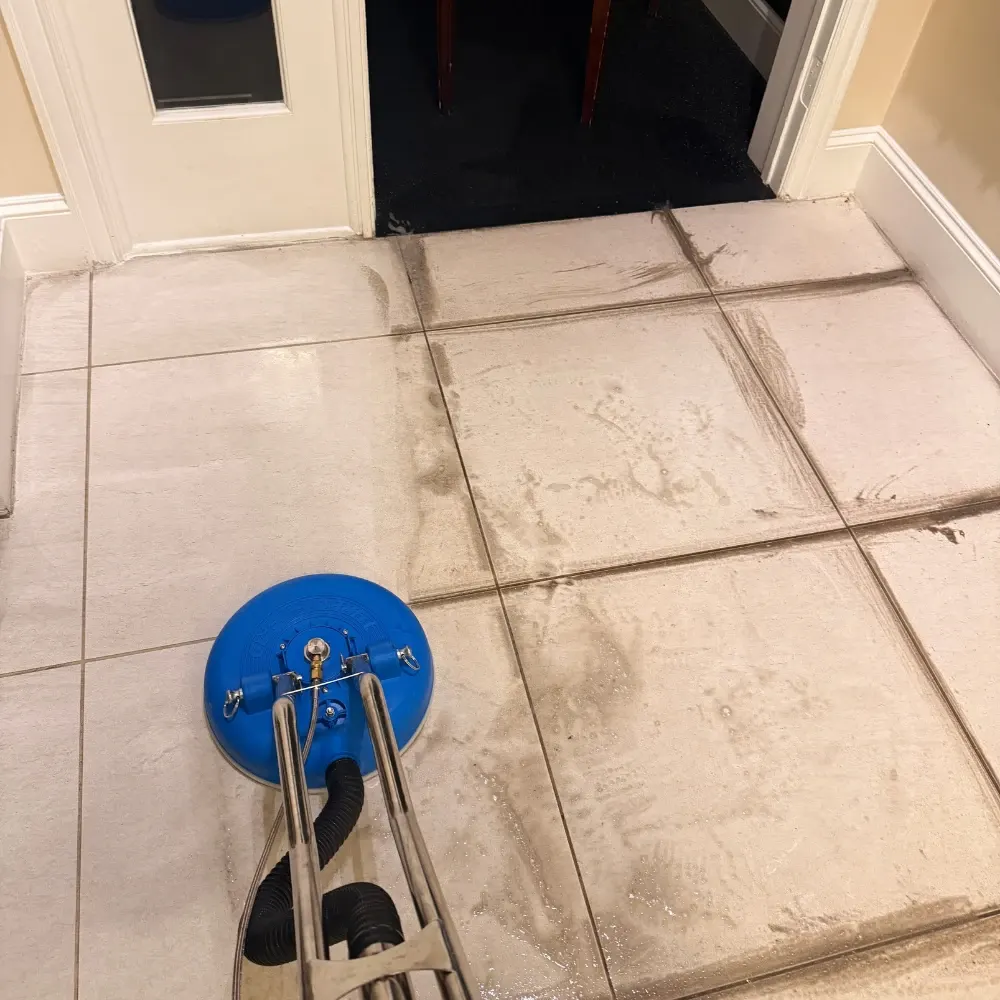
The grout is deep-cleaned first so the sealant bonds to clean grout, not to years of dirt and old cleaner.
4. Filling and color sealing
Missing grout is filled in spots, then the color sealant goes on by hand, one grout line at a time, in the color you picked. You keep a touch-up kit for small scuffs later.
How to keep grout from cracking again
You can't control the soil under your house, but you can stop making it worse, and you can give the floor room to move. These are the habits that help, starting with the ones public agencies recommend.
- Keep the soil moisture around your slab steady. TDLR's bulletin says proper surface drainage, plant choices, sprinkling practices and long-term maintenance all help minimize changes in soil moisture under a foundation. For advice on your own house and yard, ask a foundation professional.
- Make sure water drains away from the house on every side. The same bulletin says builders must make sure water drains away from the house on all sides, and homeowners should know changes in drainage can cause damage.
- Keep movement joints soft. Joints at walls, cabinets and doorways should be caulk, not grout. If yours were grouted over, a tile installer can cut them out and fill them with sealant.
- Clean with a neutral cleaner. Skip bleach and strong acids on grout. They weaken it over time, and bleach and very harsh scrubbing are what the color seal labor warranty doesn't cover.
- Wipe up water and pet accidents quickly so they don't soak into a crack.
- Watch new cracks with a pencil mark and a date. Growing cracks are worth asking a pro about early.
Cracked grout in kitchens, bathrooms and entries
Where the crack is tells you a little more about why. Here's what we see room by room.
Kitchens
Cracks along the cabinet bases and around the island are usually missing movement joints, because cabinets don't move with the floor. Cracks across the middle of a big open kitchen can be slab movement, especially in a large room with no field joints. Kitchen grout also gets the most grease and spills, so it's often the room that looks worst after a repair. Kitchen grout color sealing starts at $400.
Bathrooms
Small bathroom floors crack at the tub, the toilet and the doorway, where the tile meets another material. Upstairs bathrooms on wood framing can also crack from a floor that flexes. Bathrooms start at $250 for grout color sealing, with the $500 minimum per visit, so a bathroom is often booked with a second bathroom or the kitchen.
Entries and rooms with big glass doors
Entry tile takes the most foot traffic and, in many DFW homes, the most afternoon sun through glass. That's exactly the kind of area where the tile council's guidance calls for closer movement joint spacing. Cracks at the threshold are common for the same reason: two different materials meet there.
Natural stone and large-format tile
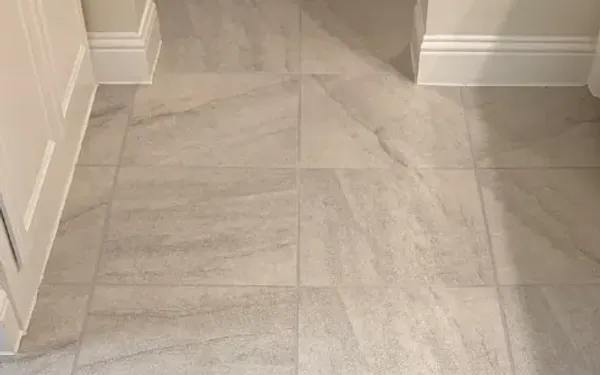
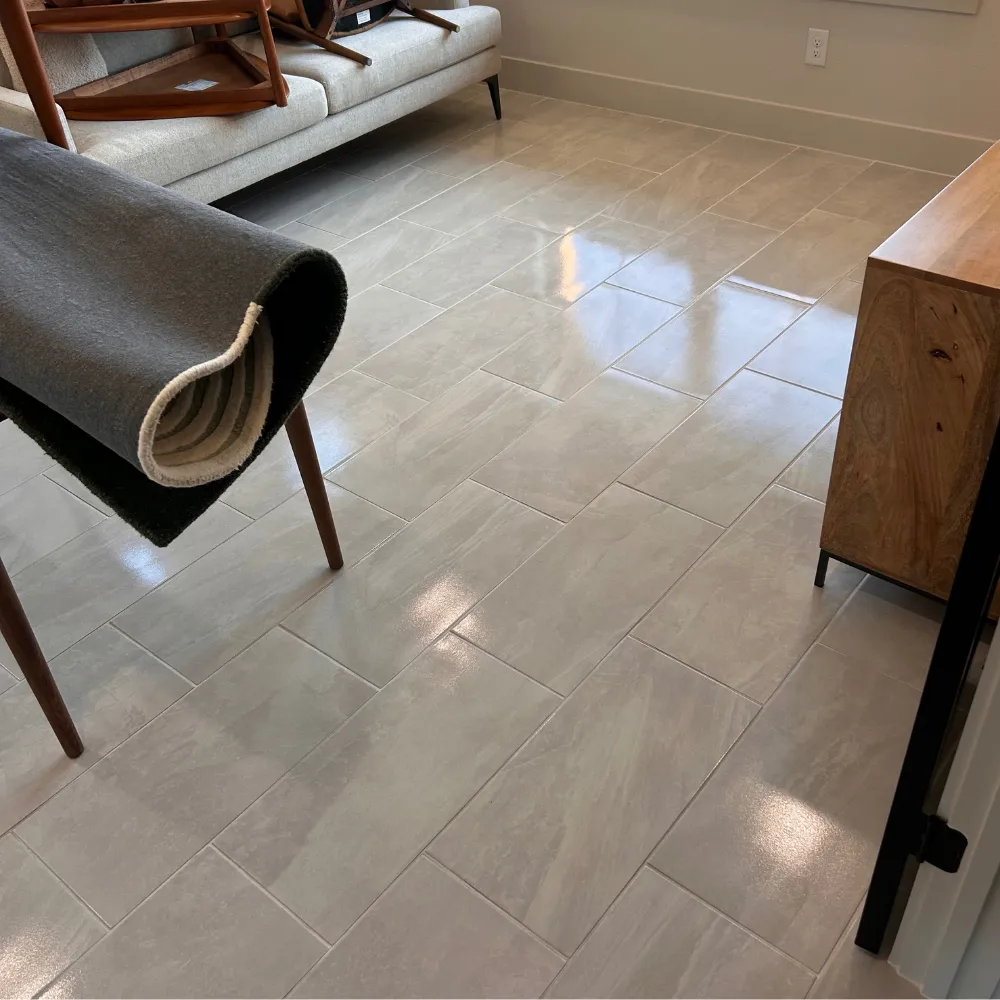
Large tiles, like the big squares in the photo at the top of this page, are stiff and need a very flat, solid floor under them. When the floor moves, large tiles crack or the grout beside them does, because a big tile can't flex across a small change underneath.
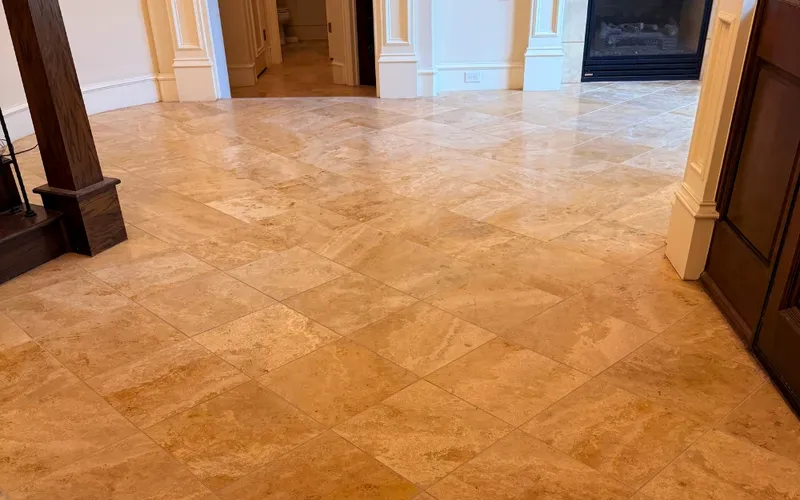
Natural stone like travertine and marble behaves differently from ceramic and porcelain and needs its own care. Grout color sealing is for ceramic and porcelain tile only. For stone, we offer a deep cleaning and a stone impregnating sealer instead, quoted as a stone job. Cracks in stone floors themselves are a stone restoration or tile repair question.
Not sure what your cracks mean? Send us photos
Text a few photos to (817) 697-7500: one of the whole room, one close-up of the worst crack, and one of any crack along a wall or cabinet. Tell us how long the cracks have been there and whether they're getting bigger. We'll tell you honestly whether it looks like a cleaning, a color seal, or something a tile installer or foundation professional should see first.
If it's a cleaning or color seal, you can see your price and book online with the form at the bottom of this page. Hank's Carpet Cleaning is a family-owned company based in Argyle with an office in Southlake, with 400+ five-star reviews and a 30-day satisfaction guarantee. We clean tile and grout across DFW, including Colleyville and Flower Mound.
Tile and grout cleaning in Colleyville · Tile and grout cleaning in Flower Mound